
Review · NIGHT & ASTRO PHOTOGRAPHY
Milky Way Photography Workshop in Acadia National Park
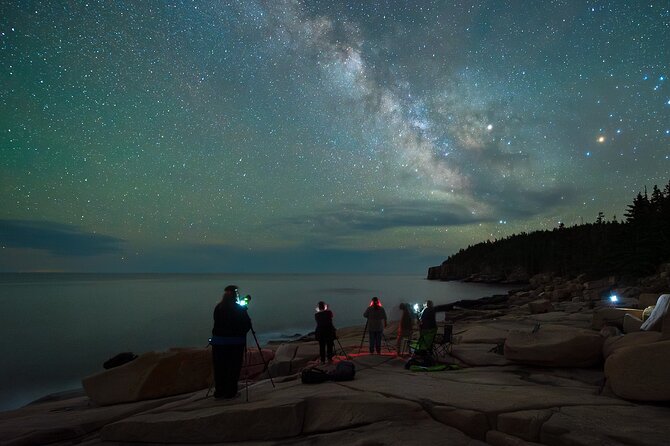
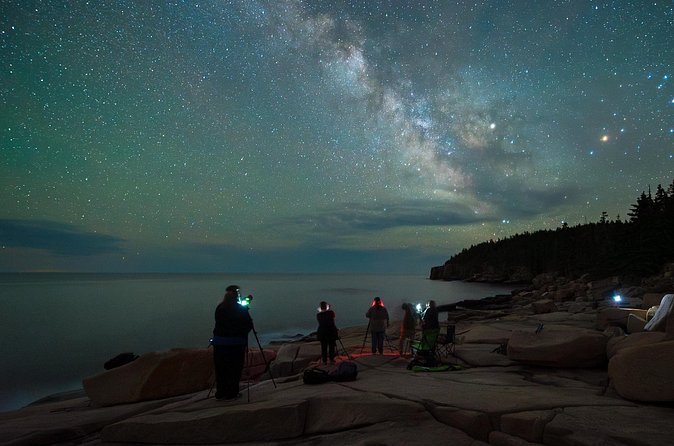
Stars meet the Maine coast. This five-day Acadia workshop gives you expert help with night photography at Jordan Pond, Otter Cliff, Sand Beach, Bubble Pond, and Eagle Lake. I especially like the small group limit of five and the blend of field instruction with a private post-processing session. The main catch is the $2,500 price, which makes the trip best for serious photographers, not casual sightseers.
I also like that the workshop teaches more than camera settings. You work on shot planning with PhotoPills, foreground composition, stacked exposures, focus stacking, time-lapse work, and Lightroom and Photoshop editing. You should also note the late hours, required gear, separate meals and lodging, and an odd fee note that refers to a Yellowstone pass for an Acadia trip. Confirm that detail before booking.
Key details before you book
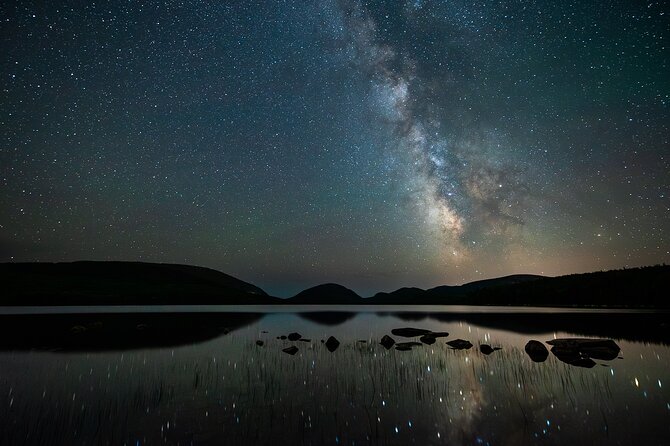
- Five-night-sky locations: Shoot at Jordan Pond, Otter Cliff, Bubble Pond, Sand Beach, and Eagle Lake.
- Small group teaching: The workshop accepts no more than five people, allowing close help in the field.
- Private park transportation: All workshop travel inside Acadia National Park is covered, with water and snacks in the vehicle.
- Real editing practice: Learn single exposures, stacked images, foreground blends, focus stacking, panoramas, and time-lapse workflows.
- Late operating hours: Sessions are listed from midnight to 3:30 a.m. and from 7:00 p.m. to 11:30 p.m., Tuesday through Saturday.
- Serious camera requirements: Bring a DSLR or mirrorless camera, a fast wide-angle lens, a sturdy tripod, and an intervalometer if needed.
What the $2,500 price really buys you
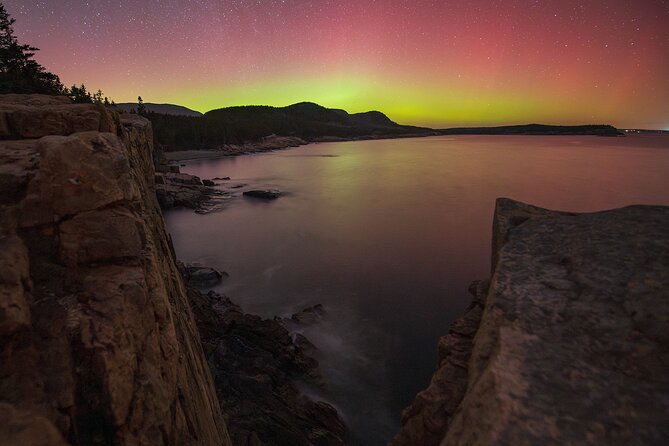
At $2,500 per person, this is not a cheap night out with a camera. It is a specialized photography course built around several field sessions, private transportation, expert instruction, and a one-on-one editing lesson through Discord.
The value depends on your goal. If you want a few pretty star pictures for social media, the cost is hard to justify. If you want to understand how professional night images are planned, captured, blended, and edited, the price makes more sense.
The small group matters here. With a maximum of five people, you should have a better chance of getting direct help with focusing, exposure, composition, and camera setup. That is far more useful than standing in a large crowd while an instructor gives general advice.
You also avoid driving between dark park locations yourself. Private transportation covers travel within Acadia, and water and snacks are supplied in the vehicle. Meals and lodging are not included, so your total budget will be higher than the workshop fee.
The course also appears to offer more than one evening of shooting, though the exact timing across the five-day program is not fully spelled out. The listed operating hours show two possible blocks: midnight to 3:30 a.m. and 7:00 p.m. to 11:30 p.m. That means you need to be comfortable with very late nights and a schedule shaped by darkness and weather.
More Night and Astro Photography in the USA:
- Mauna Kea Stargazing Experience + Photos
★ 5.0 · 261 reviews - Private Guided Night Photography Tours on Cape Cod (for one photographer.)
★ 5.0 · 38 reviews - Moab: The Windows Astro-Photography and Stargazing Hike
★ 4.8 · 36 reviews
Jordan Pond, reflections and careful composition
Jordan Pond is one of the workshop’s strongest stops because it gives you a calm water setting for night photography. The pond can provide reflections and a clean foreground, while the surrounding mountains add shape and scale behind the sky.
This is a useful place to practice the workshop’s main compositional lesson: the Milky Way should not float by itself in an empty frame. Rocks, water, mountains, trees, or shoreline details give the image a sense of place.
You will likely work on more than one exposure here. A shorter exposure can preserve detail in the stars, while a longer exposure can bring out the foreground. The final image may then require blending in Photoshop.
That process is important for beginners because night photography often asks the camera to handle two very different light levels at once. The sky may need one exposure, while the ground needs another. Learning to combine them gives you more control than simply raising the ISO and hoping for the best.
Jordan Pond also seems well suited to focus stacking. You may need sharp detail in a nearby foreground object and clarity in the distant view. The workshop teaches focus stacking as part of its editing and capture process, giving you a useful technique for more than just astrophotography.
Otter Cliff, stars above the Atlantic
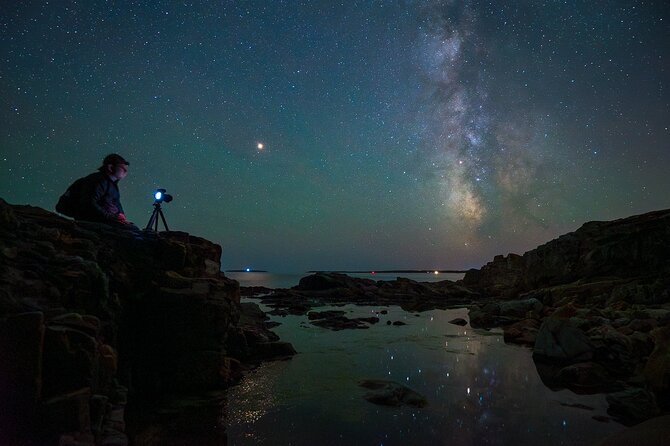
Otter Cliff brings the coast into the picture. Its rock formations and open ocean setting give you a stronger sense of drama than a quiet inland pond.
This is where the workshop’s idea of celestial storytelling becomes practical. Instead of treating the Milky Way as a decoration, you use the cliff and sea to show scale, direction, and movement. The coastal elements help explain where the image was made.
The location also brings a practical challenge. Rocks and open shoreline can make composition more demanding, especially in the dark. You need to pay attention to tripod placement, foreground lines, and safe movement. The stated moderate fitness requirement is worth taking seriously, even though the program does not give a detailed walking description.
At Otter Cliff, you may also work with a longer exposure for the foreground or use multiple frames for a more finished image. The goal is not just to point a wide lens upward. You learn how to build a frame that includes the coast and uses the stars to guide the eye.
Bubble Pond, a quieter change of pace
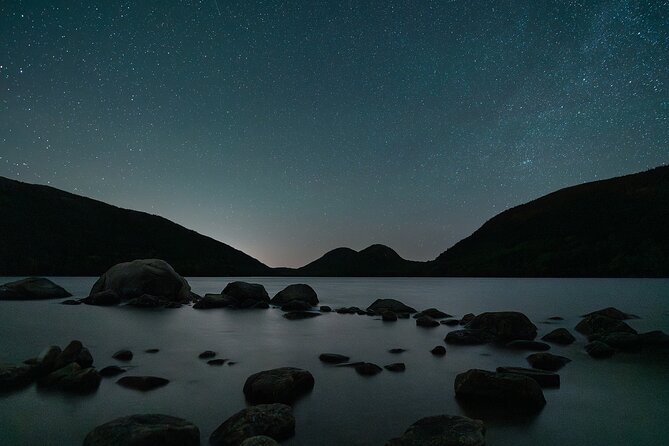
Bubble Pond offers another type of night scene. Compared with the exposed coast at Otter Cliff and Sand Beach, it gives the group a different setting for experimenting with water, trees, and mountain shapes.
That variety is one of the program’s strengths. You are not repeating the same star shot five times. Each place asks you to think about the foreground in a new way.
A wooded or enclosed setting can also expose weaknesses in your technique. You may need to decide how much of the foreground should remain dark and how much detail you want to recover in editing. This is where instruction in Lightroom and Photoshop becomes useful.
The workshop also covers time-lapse photography, including moving clouds and stars. Bubble Pond could provide a strong setting for testing that kind of work, although the exact exercise at each location is not specified. If time-lapse interests you, ask how much time the program gives to capture and process sequences.
More Photography Workshops and Lessons in the USA:
- 2-Hour Photography Class While Touring Downtown Santa Fe, Smart Phones Welcome!
★ 5.0 · 108 reviews - Custom Half-Day Photo Tour with Photography Lessons from Asheville
★ 5.0 · 43 reviews - Private Digital Photography Workshop
★ 5.0 · 4 reviews - Paris Photography Masterclass – Private Photography Lesson
★ 5.0 · 112 reviews
Sand Beach, open sky and coastal scale
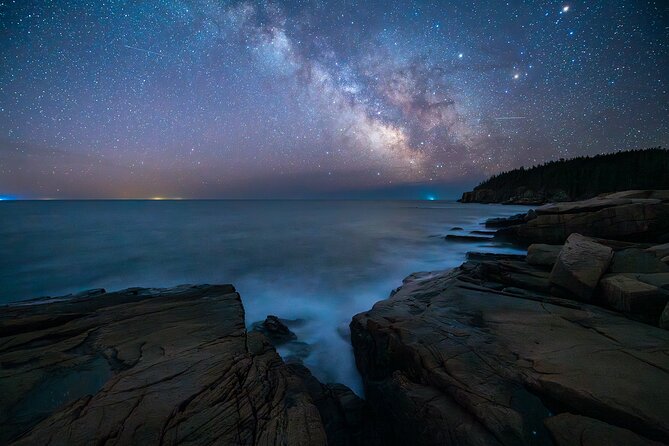
Sand Beach gives you a broad coastal foreground and a clear sense of space. The beach can help you create a simple composition with sand below, water or rock forms beyond it, and the night sky above.
Simple scenes can be surprisingly difficult. Without a strong foreground subject, the picture may feel empty. The instruction on adding foreground elements should help you use shoreline shapes, rocks, and the curve of the beach to give the frame structure.
This is also a good setting for learning how celestial movement changes a photograph. Star trails, moving clouds, or a changing Milky Way position can turn a static scene into a record of time. The workshop focuses on that relationship between sky movement and coastal forms.
The practical issue is darkness. A beach is not a place where you should rush between compositions or handle gear carelessly. You will need a sturdy tripod, manual camera control, and a good understanding of your equipment before arriving. The course is designed for people who already understand basic manual settings, so it is not a first lesson in photography.
Eagle Lake, a final test of your planning
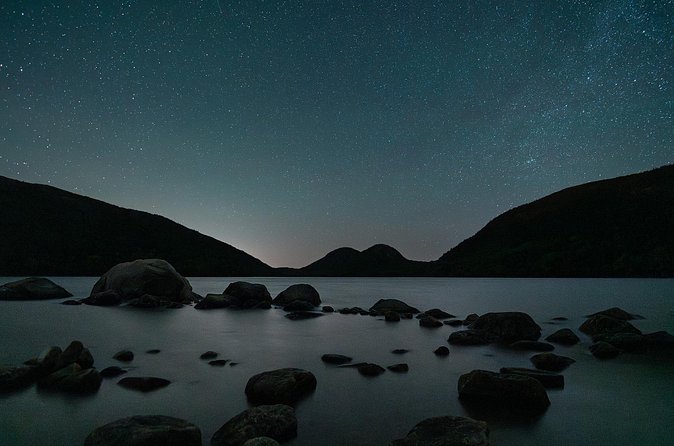
Eagle Lake rounds out the location list with another inland setting. Like Jordan Pond and Bubble Pond, it can help you practice placing water and distant forms beneath the stars.
Planning matters at every stop. The workshop teaches you to use PhotoPills to work out where and when the Milky Way will appear in relation to the scene. That can help you decide the best direction for your camera before you arrive, instead of wandering around in the dark hoping for a lucky frame.
This is one of the most useful skills in the course. A strong night image often depends on preparation long before the shutter opens. You need to know the moon conditions, the Milky Way’s position, the composition you want, and the sequence of exposures required.
The program does not promise clear skies every night. It requires good weather, and poor conditions can lead to a new date or a full refund. That policy is reassuring, but you should still leave room in your wider Maine plans for a weather change.
What you will learn in the field
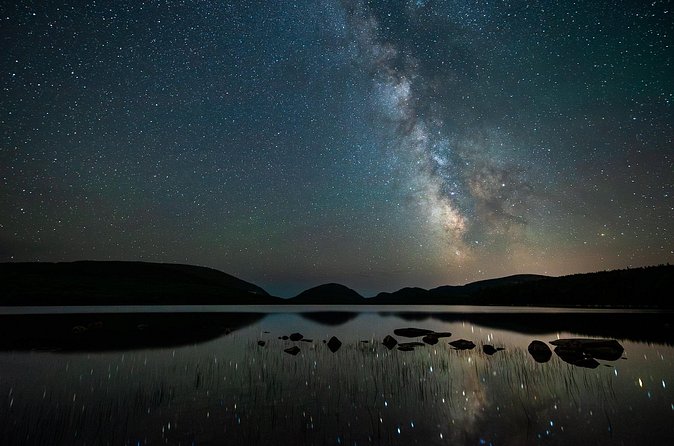
The instruction covers both basic capture decisions and more advanced image-making. You should expect hands-on work with:
- Single-exposure Milky Way images
- Stacked night-sky frames
- Separate sky and foreground exposures
- Focus stacking
- Panoramas of the Milky Way
- Time-lapse photography
- Foreground composition
- PhotoPills planning
- Lightroom and Photoshop editing
The distinction between single exposures and stacked images matters. A single frame is quicker and simpler, while stacking can help reduce noise or improve detail. The right approach depends on your subject, movement in the sky, and the look you want.
The course also teaches you how to process the image after the camera work is finished. That is a major benefit. Many people can copy a camera setting, but fewer understand how to organize, blend, sharpen, and balance a night image afterward.
The separate one-on-one Discord session is especially useful if you return home with unfinished files or questions. You can use that time to revisit the editing process instead of trying to remember every lesson from a long night in the park.
The instructor and teaching style
Christopher, also called Chris, receives the strongest praise for his calm, patient teaching style and wide range of skills. His instruction covers night photography, time-lapse, video, and regular outdoor photography, so you are not limited to one narrow technique.
The classroom and field work are designed to support each other. You learn the reason behind a setting, then apply it outside at a real location. That structure is more useful than collecting isolated tips.
Past participants also describe learning to expose the Milky Way and foreground separately, then blend the frames in Photoshop. Focus stacking and time-lapse processing are additional skills that can carry over to other types of photography.
Chris also has a reputation for remaining available after the workshop for questions. The included Discord session gives that support a defined place in the program, which is helpful if you need feedback once you are working alone.
Equipment and fitness requirements
You need a DSLR or mirrorless camera capable of long exposures. A wide-angle lens with an aperture of f/2.8 or faster is required, along with a sturdy tripod.
You should also bring an external intervalometer if your camera does not have one built in. This tool matters for timed sequences, stacked frames, and time-lapse work.
The course assumes a basic understanding of manual settings and post-processing. You do not need to arrive as an expert, but you should know how to adjust shutter speed, aperture, and ISO, and you should have some experience handling your camera in low light.
A moderate fitness level is required. The exact distances and terrain are not provided, so ask for more detail if walking, standing, or uneven ground could be a concern. Service animals are allowed.
Schedule, group size and practical planning
The experience is offered in English and pickup is available. All transport within Acadia National Park is included, but lodging, meals, and the park entrance fee are separate.
The published fee information contains a confusing reference to a valid Yellowstone National Park pass, even though the workshop takes place in Acadia. It also lists $20 per person. I would confirm the correct Acadia entrance requirement and current amount before paying.
The maximum group size is five, a strong point for anyone who wants close instruction. The listed dates run from April 26, 2024, through June 20, 2026, with sessions Tuesday through Saturday during the two late-day and overnight time blocks.
Because the program depends on darkness and clear weather, you should not plan a packed morning schedule after a midnight to 3:30 a.m. session. The experience is better suited to someone who can give the workshop room in their itinerary.
Free cancellation is available up to 24 hours before the start time. A cancellation inside that window is not refundable. If poor weather or an insufficient number of bookings cancels the workshop, you can receive a new date or a full refund.
Who should book this Acadia workshop?
I would recommend it to photographers who already understand manual camera operation and want to improve their night work. It is particularly suitable if you want to learn the full process, from PhotoPills planning through field capture and Photoshop finishing.
It also suits photographers who enjoy learning in a small group. The chance to ask direct questions at five major Acadia locations is more valuable than a generic sightseeing tour for this audience.
I would not choose it if you are mainly looking for a relaxed park tour, have no long-exposure camera gear, or do not want to edit images afterward. The late hours, separate accommodation costs, and $2,500 fee require a real commitment.
FAQ
Where does the workshop take place?
The workshop takes place in Acadia National Park near Bar Harbor, with sessions at Jordan Pond, Otter Cliff, Bubble Pond, Sand Beach, and Eagle Lake.
How long does the experience last?
The workshop lasts approximately five days.
What is included in the price?
Private transportation within Acadia National Park, expert instruction, bottled water and snacks in the transport vehicle, and a one-on-one post-processing session through Discord are included.
Are meals and lodging included?
No. Meals and lodging are not included.
What camera equipment do I need?
You need a DSLR or mirrorless camera capable of long exposures, a wide-angle lens with an aperture of f/2.8 or faster, a sturdy tripod, and an external intervalometer if your camera does not have one built in.
How many people can join?
The workshop has a maximum of five participants.
Is the park entrance fee included?
No. An entrance fee is listed separately at $20 per person, but the provided information refers to a Yellowstone pass for an Acadia workshop. Confirm the correct park fee before booking.
What happens if the weather is poor?
If poor weather causes a cancellation, you will be offered another date or a full refund. You can also cancel for a full refund if you do so at least 24 hours before the experience starts.
Should you book it?
Book this workshop if you want serious, practical help with night photography and can use the skills beyond one trip. The small group, private transport, Acadia locations, and post-processing support give the $2,500 fee a clear purpose for committed photographers.
Skip it if you want a low-cost stargazing outing or a simple photo stop. You need the right gear, a moderate fitness level, patience with late nights, and a willingness to edit your work. Confirm the Acadia entrance fee and exact five-day schedule first, then this can be a powerful way to come home with better images and better habits.
More National Park Trips around the USA
- Half-Day Rocky Mountain National Park “Mountains to Sky Tour” – RMNPhotographer
★ 5.0 · 89 reviews - Private Guided Photography & Walking Tour of Zion National Park
★ 5.0 · 75 reviews - Full-Day Rocky Mountain National Park “Over The Top Tour” – RMNPhotographer
★ 5.0 · 42 reviews - Exquisite Wildlife & Wilderness Photo Tour Anchorage -Whittier
★ 5.0 · 12 reviews
Just added around the USA
- Private Wynwood Miami Photoshoot★ 3.0 · 2 reviews
- Private Sunset and Night Photo Tour★ 5.0 · 3 reviews
- Private Vacation Photography Session with Local Photographer in Miami★ 3.0 · 2 reviews
- Miami: Professional Private Photoshoot at Miami Beach★ 5.0 · 2 reviews
- Photographer, Professional Photo Shoot – Miami★ 3.0 · 2 reviews
- Private Vacation Photoshoot with Photographer in Lahaina★ 5.0 · 2 reviews
- Private Road To Hana Tour with Professional Photos Included★ 5.0 · 19 reviews
- Professional Photographer in Maui★ 4.5 · 3 reviews
Night & Astro Photography, compared.
Tokyo by Night Photography Tour (Private Option Available)
Read our review →
Night Photo Session in a Fiat 500 with Aperol Spritz
Read our review →
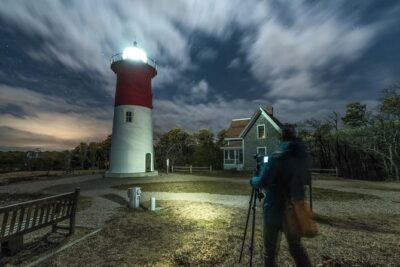
Private Guided Night Photography Tours on Cape Cod (for one photographer.)
Read our review →
Moab: The Windows Astro-Photography and Stargazing Hike
Read our review →Browse the lists this shoot appears in